
Does Caffeine Really Help With Hair Growth? What the Science Says
Caffeine shampoos have become a fixture in the hair growth category, but the claims often run ahead of the evidence. Here is a straightforward look at what the research actually shows, and why the source of caffeine matters more than most brands let on.

Why caffeine became a hair ingredient
The interest in caffeine for hair growth is not new. Researchers began investigating topical caffeine in earnest in the early 2000s, largely because of its well-established ability to penetrate the skin barrier quickly and interact with cellular processes at the follicle level. What makes it relevant to hair loss is a specific biological mechanism: its effect on DHT.
DHT (dihydrotestosterone) is a hormone derived from testosterone and is the primary driver of androgenetic alopecia, the most common form of hair loss in both men and women. DHT binds to receptors in the hair follicle and progressively shrinks it over time, shortening the growth phase (anagen) and causing finer, shorter hairs with each cycle until the follicle stops producing hair altogether.
Caffeine has been shown to counteract this process at the cellular level. A 2007 study by Fischer et al., published in the International Journal of Dermatology, found that caffeine stimulated hair shaft elongation and counteracted the suppressive effects of testosterone on hair follicle growth in vitro. Importantly, the caffeine penetrated the follicle within just two minutes of contact with the scalp.
Fischer et al., International Journal of Dermatology, 2007
What does caffeine actually do to the hair follicle?
Caffeine works on hair follicles primarily by inhibiting phosphodiesterase, an enzyme that breaks down cyclic AMP (cAMP). cAMP is a signalling molecule that promotes cell proliferation and growth. When phosphodiesterase is inhibited, cAMP levels rise, and follicle cells are stimulated to divide and grow more actively.
In practical terms, this appears to:
- Extend the anagen (active growth) phase of the hair cycle
- Increase the length and diameter of the hair shaft
- Counteract the follicle-shrinking effects of DHT
- Stimulate circulation in the scalp, improving nutrient delivery to the follicle
It is worth being clear about what this does not mean. Caffeine is not a cure for hair loss, and topical application is not equivalent to pharmaceutical treatments. As a natural, supportive ingredient with a credible mechanism of action and a strong safety profile, however, it has a genuine role to play.

Why guarana seeds are a better caffeine source for hair
Not all caffeine sources deliver the same thing. Most caffeine used in hair products is synthetic (anhydrous caffeine), which is inexpensive and consistent but stripped of the surrounding compounds found in natural sources.
Guarana seeds (Paullinia cupana), native to the Amazon basin, contain roughly twice the caffeine concentration of coffee beans by weight. What sets them apart for topical use is what comes alongside the caffeine:
What guarana seeds contain
- High-potency caffeine at approximately 2–4.5% caffeine by dry weight, compared to around 1–2% in coffee
- Tannins, naturally occurring compounds that bind to caffeine and create a slow-release effect, meaning the caffeine is delivered more gradually to the scalp
- Theobromine and theophylline, related xanthines with their own mild stimulant and anti-inflammatory properties
- Antioxidants including catechins that may help protect the scalp from oxidative stress, a known contributor to hair thinning
- Saponins, compounds with natural cleansing properties, relevant for a shampoo formulation
The tannin-bound caffeine in guarana behaves differently from isolated synthetic caffeine. Because the tannins slow the breakdown and absorption of caffeine, the effect at the follicle level is thought to be more sustained. Guarana has historically been prized for its more prolonged energising effect compared to coffee, and the same principle may apply when it is used topically on the scalp.
Does it matter how you apply caffeine to the scalp?
Yes, and this is where most caffeine shampoos fall short. Conventional liquid shampoos are largely water. Caffeine is water-soluble, which means it competes with a large amount of water in the formula, and the product is rinsed off quickly. The window of contact between the caffeine and the scalp is brief.
A shampoo powder changes this equation. Because there is no water in a dry powder formula, the caffeine concentration relative to the total product is higher. When the powder is activated with water at the scalp, the caffeine is delivered in a more concentrated form and the lathering process keeps it in contact with the scalp for longer than a pre-diluted liquid allows.
This is not a trivial distinction. Effective topical caffeine delivery has been shown to require a minimum contact time of around two minutes, something the Fischer study specifically noted. A concentrated powder format, used attentively, is more likely to meet that threshold than a thin, heavily diluted liquid shampoo that washes away almost immediately.
What the evidence says, and what it does not
It is important to be honest about the state of the research. Most studies on topical caffeine and hair growth have been conducted in vitro (on isolated follicle cells) or in small clinical trials. The evidence is genuinely promising, but it is not yet at the scale or consistency of pharmaceutical hair loss treatments.
What the research does support, with reasonable confidence:
- Caffeine penetrates the scalp and reaches the hair follicle
- It stimulates follicle cell growth and extends the anagen phase in laboratory conditions
- It has a measurable countereffect on DHT-driven suppression of follicle activity
- Topical application avoids the systemic side effects associated with oral DHT blockers
What we cannot yet say with certainty is the optimal concentration, the minimum effective contact time in a real-world setting, or how topical caffeine compares head-to-head with established pharmaceutical treatments in large-scale human trials.
For someone dealing with early-stage thinning or looking to support scalp and hair health as a long-term habit, caffeine is one of the most evidence-backed natural ingredients available. For someone with significant hair loss, it is best understood as a complement to medical advice rather than a replacement for it.
Awake Organics
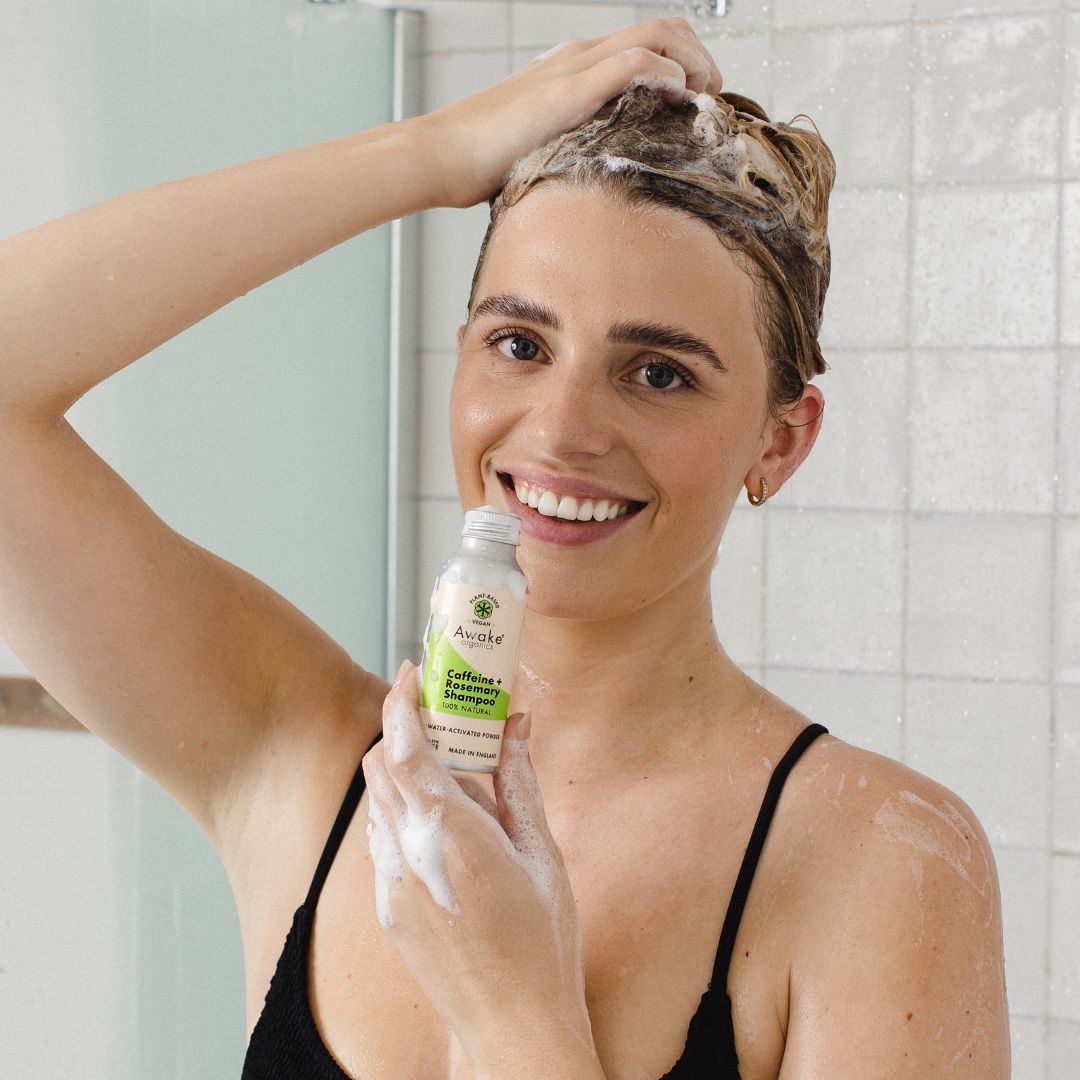
Caffeine + Rosemary Shampoo Powder
Formulated with guarana seed caffeine and rosemary oil. No water, no sulphates, no fillers. A concentrated powder that activates at the scalp.
View the productHow long does it take to see results?
Hair growth is slow. The anagen phase of a single hair follicle lasts between two and seven years, and the visible effects of any topical treatment take time to manifest. Most studies looking at topical caffeine interventions have used timeframes of three to six months as their assessment window.
Consistency matters far more than intensity. Washing with a caffeine shampoo powder three to five times per week is a realistic and sustainable routine for most people, and aligns well with how frequently most clinical studies have applied topical treatments. Washing every day can strip the scalp of its natural oils, so finding a frequency that suits your hair type is worth paying attention to.
Early results, if they appear, are more likely to present as reduced shedding and improved hair texture before any visible regrowth becomes apparent.
Common questions
Does caffeine shampoo actually work for hair growth?
Research suggests caffeine can penetrate the scalp and stimulate hair follicles by blocking DHT, a hormone linked to hair loss. Studies show it may extend the hair growth phase and increase follicle size. Results are gradual and work best as part of a consistent routine.
Is guarana caffeine better than regular caffeine for hair?
Guarana seeds contain roughly twice the caffeine concentration of coffee beans and also deliver tannins and antioxidants that may support scalp health. The slow-release nature of guarana caffeine is thought to provide a more sustained effect at the follicle level.
How long does caffeine shampoo take to work?
Most studies looking at topical caffeine for hair used timeframes of three to six months. Hair growth is a slow process and topical treatments require consistent, long-term use to show measurable results.
How often should I use caffeine shampoo?
Three to five times per week is the sweet spot for most people. Washing more frequently can strip the scalp of its natural oils, which is counterproductive to scalp health. Regular, consistent use over several months is what drives results.
Why use a shampoo powder instead of a liquid caffeine shampoo?
Conventional liquid shampoos are largely water, which dilutes active ingredients and reduces their concentration at the scalp. A powder formula delivers a higher concentration of caffeine per use and activates directly at the scalp, improving contact time with the follicle.