Breakouts don't always stop at 25. For plenty of us they turn up again in our 40s and 50s, often alongside skin that's drier and more sensitive than it used to be. These are the five essential oils we reach for, what each one is known for, and how to use them well.

What's behind a breakout
Four things usually work together. Skin makes more oil than it needs. Oil and dead cells block a pore. Bacteria that normally live quietly on skin (Cutibacterium acnes) multiply inside that blocked pore. Skin responds with redness and swelling. Each oil below helps with one or two of these, which is why they work best in combination.
Hormonal breakouts in your 30s, 40s and beyond
Adult breakouts are very often hormonal, and they behave differently from teenage spots. They tend to gather along the chin, jaw and lower cheeks. They sit deeper, feel tender, and take their time to go, sometimes leaving a mark behind.
Hormones are the reason. Androgens (hormones like testosterone) encourage the skin's oil glands to produce more sebum. Through your 30s and 40s, many women notice a flare in the days before a period, when oestrogen dips. Then in perimenopause, oestrogen starts to fall for good while androgens stay relatively steady. The balance tips, and skin that hasn't broken out in decades suddenly does.
The complication is that the same drop in oestrogen also leaves skin thinner, drier and slower to repair. So you can find yourself with spots and dryness at the same time, on skin that's more easily irritated than it used to be. The drying approach that tamed teenage spots, like strong alcohol toners and high-strength benzoyl peroxide, often backfires here. It can leave skin tight and flaky, and the barrier more reactive.
A little goes a long way
Essential oils are highly concentrated, so they only ever play a supporting role. In a face oil they make up a tiny fraction of the formula, carried in plant oils that do the everyday work of balancing and softening. We buy ours undiluted and unaltered, certified organic, because at these small amounts quality is everything.
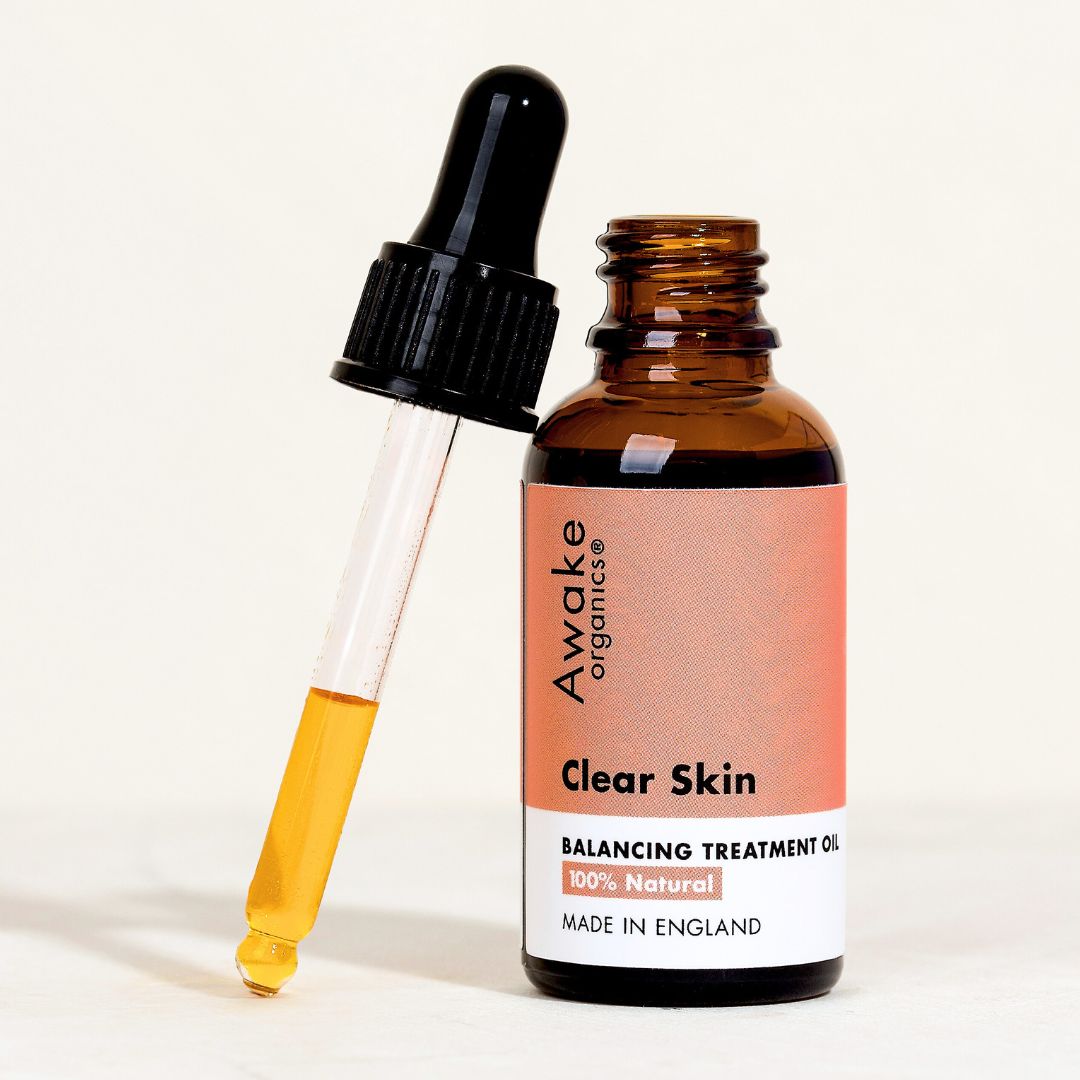
All five of the oils below go into our Clear Skin Balancing Treatment Oil, carried in a base of hemp seed, evening primrose, rosehip and camellia oils. It's the blend we made for exactly the skin this article is about: grown-up, breakout-prone, and in need of comfort as much as clearing.
1. Tea tree
Best for: red, tender spots, including the jawline breakouts that come with hormonal shifts.
Fresh, green and a little medicinal. Tea tree is the most researched essential oil for blemish-prone skin. Its key compound, terpinen-4-ol, is active against the bacteria that multiply in blocked pores, and it has also been studied for calming inflammation. In one early study, a 5% tea tree gel was compared with 5% benzoyl peroxide: both reduced spots, and while tea tree worked more slowly, people reported less dryness and stinging.1 A later placebo-controlled trial of a 5% gel found similar promise.2
Tea tree oxidises as it ages, and old oil is far more likely to irritate. Fresh matters more here than with almost any other oil.
2. Rosemary
Best for: dull, congested skin that looks tired.
Sharp, herbaceous and wide awake. That warming-then-cooling tingle comes from compounds like camphor and 1,8-cineole, and rosemary is traditionally used to stimulate circulation and tone the skin. For congested skin, that means a brighter, fresher look. If you know us for anything, it's probably rosemary, and we've spent years with it in scalp care.
3. Lavender
Best for: breakouts on skin that's also sensitive or easily flushed.
Floral, with a woody undertone. Lavender's calming reputation comes largely from two compounds, linalool and linalyl acetate. It's traditionally used to soothe skin and calm the look of redness while a blemish settles, which makes it a natural fit for skin that's breaking out and sensitive at the same time.
4. Patchouli
Best for: skin that's breaking out and dry at the same time, the classic perimenopause combination.
Warm and earthy, with a surprising hint of fruit. Most oils for blemishes lean drying. Patchouli doesn't. In aromatherapy it's traditionally used for dry, mature and blemish-prone skin all at once, and to help soften the look of marks left behind. That combination is exactly why we value it for adults breaking out in their 40s and 50s. Its grounding scent is a quiet comfort on busy days, too.
5. Grapefruit
Best for: an oily T-zone and pores that look larger by midday.
Bright, sharp and instantly cheering. Grapefruit is astringent, giving skin a gently tightening, fresher feel, and it's traditionally used to tone oily skin and refine the look of pores. It's the lightest-feeling oil of the five, and its scent does as much for your morning as it does for your skin.
Pressed grapefruit oil can make skin more sensitive to sunlight at higher strengths, but in a well-formulated product it's used at levels well below where that becomes a concern.
Using essential oils on your face
- Always dilute. Around 1% is plenty for the face: roughly one drop per teaspoon (5ml) of carrier oil.
- Keep neat oils off the wider face. Tea tree dabbed onto a single spot is the exception.
- Patch test on your inner arm and wait 24 hours.
- Store capped, cool and dark. Oils past their best are the most likely to irritate or clog pores.
Common questions
Which essential oil is best for hormonal breakouts?
Tea tree is the one to start with, as it's the most studied for spots. If your skin is also drier than it used to be, pair it with patchouli, which brings comfort as well as clarity. In practice, a blend works better than any single oil, because hormonal breakouts rarely have just one cause.
Can I put tea tree oil straight on a spot?
Yes. Tea tree is one of the few essential oils traditionally dabbed neat onto a single spot. Touch it on with a cotton bud and keep it to the blemish itself, away from the skin around it. Fresh oil matters here, as tea tree that has oxidised is far more likely to sting. If your skin is very sensitive, a drop mixed into a little face oil works gently too.
How long before I notice a difference?
Give any new routine at least four to six weeks. Skin renews itself more slowly as we get older, and tea tree in particular works steadily rather than overnight. It's a slow build, but a gentle one.
Can essential oils balance my hormones?
No, and nothing you put on your skin will. What they can do is support the skin itself: helping keep pores clear, calming redness, and keeping everything comfortable while your body adjusts. If breakouts are deep, painful or not settling, it's worth a conversation with your GP, as there are good options available.
Can I use essential oils alongside retinol or other active skincare?
Yes, but introduce one new thing at a time, so you know what your skin is responding to. If a retinol or acid is already leaving your skin dry or sensitive, keep the two to separate times of day, and let a nourishing face oil do the comforting.
Won't putting oil on oily skin make it worse?
Not necessarily. The right plant oils help skin feel balanced rather than stripped, and stripping oily skin can prompt it to produce more. Light oils rich in linoleic acid, like hemp seed and evening primrose, are a good place to start, which is why they form the base of our Clear Skin Balancing Treatment Oil.
References
1. Bassett IB, Pannowitz DL, Barnetson RS. A comparative study of tea-tree oil versus benzoylperoxide in the treatment of acne. Med J Aust. 1990;153(8):455-8. doi:10.5694/j.1326-5377.1990.tb126150.x
2. Enshaieh S, Jooya A, Siadat AH, Iraji F. The efficacy of 5% topical tea tree oil gel in mild to moderate acne vulgaris: a randomized, double-blind placebo-controlled study. Indian J Dermatol Venereol Leprol. 2007;73(1):22-5. doi:10.4103/0378-6323.30646